

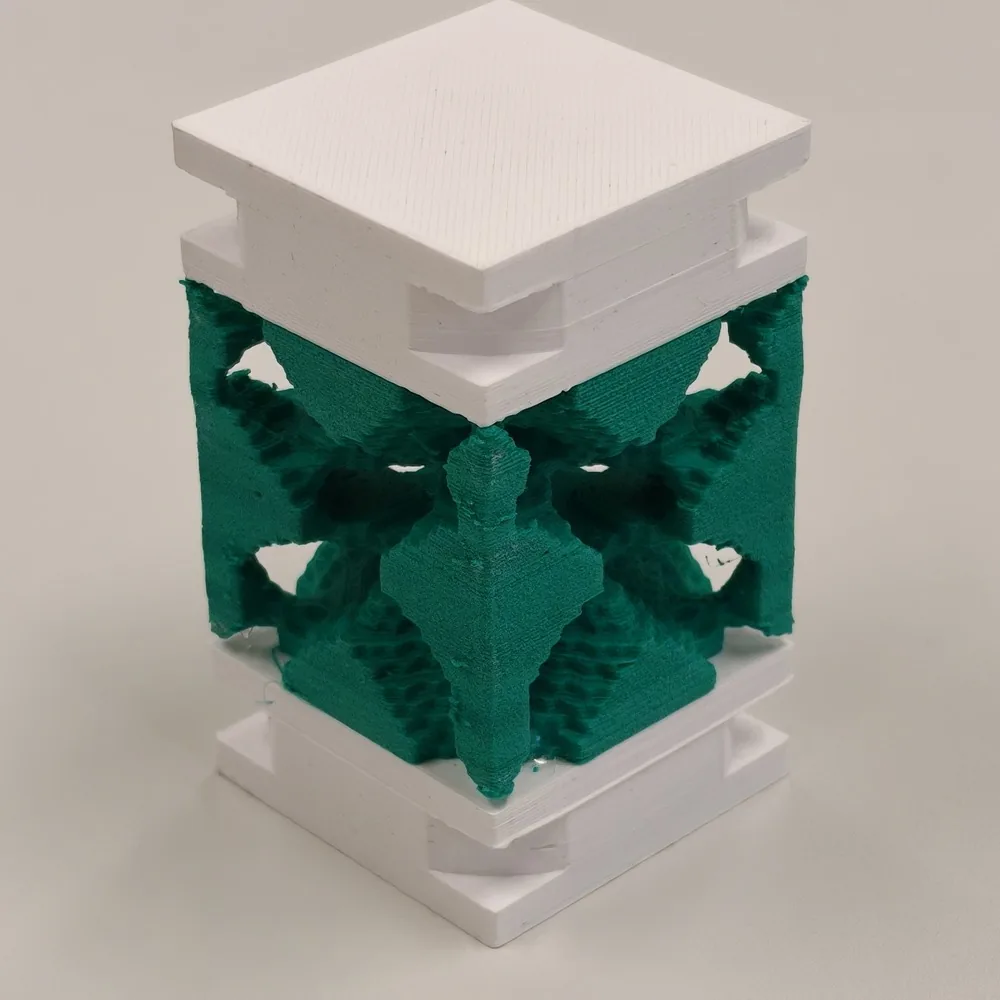
An Open-Source Solver and Multi-Material 3D Printing
Elias Huber · Bachelor of Science ETH in Mechanical Engineering
Thesis supervisor: Dr. Millicent Schlafly · IDEAL – Chair of Artificial Intelligence in Engineering Design, D-MAVT
Autumn Semester 2026
Compliant structures that must bend far are designed as a density field, but a printer can only deposit solid material. This thesis follows that design through three steps and measures each one on its own terms.
DOWNLOAD THE THESISElias Huber is a former AISCO Focus Student at IDEAL, ETH Zurich, and was part of the CFD AI team. He has now completed his BSc thesis at IDEAL.
A compliant structure that must reach large deflections is designed as a continuous density field, yet a printer can only lay down solid material. Several transformations sit between the design and the printed part. This thesis examines three of them: how the solver approximates the physics, where the density threshold is placed, and how the filament is deposited.
The design loop is rebuilt on Firedrake, an open-source finite-element framework, using a mixed Q1P0 element and a taped adjoint. The original cube, motions and optimization settings are kept, the loop runs without a commercial license, and it scales across processors. On the one field that both codes can solve, the stored energy differs by 6 to 36 % from the original Abaqus pipeline; hourglass control and the integration rule are ruled out as the cause. The linear model changes the design on every axis that can be read, most of all on the rotations. Five separate single-axis designs reach 7.0 mm and 0.40 rad.
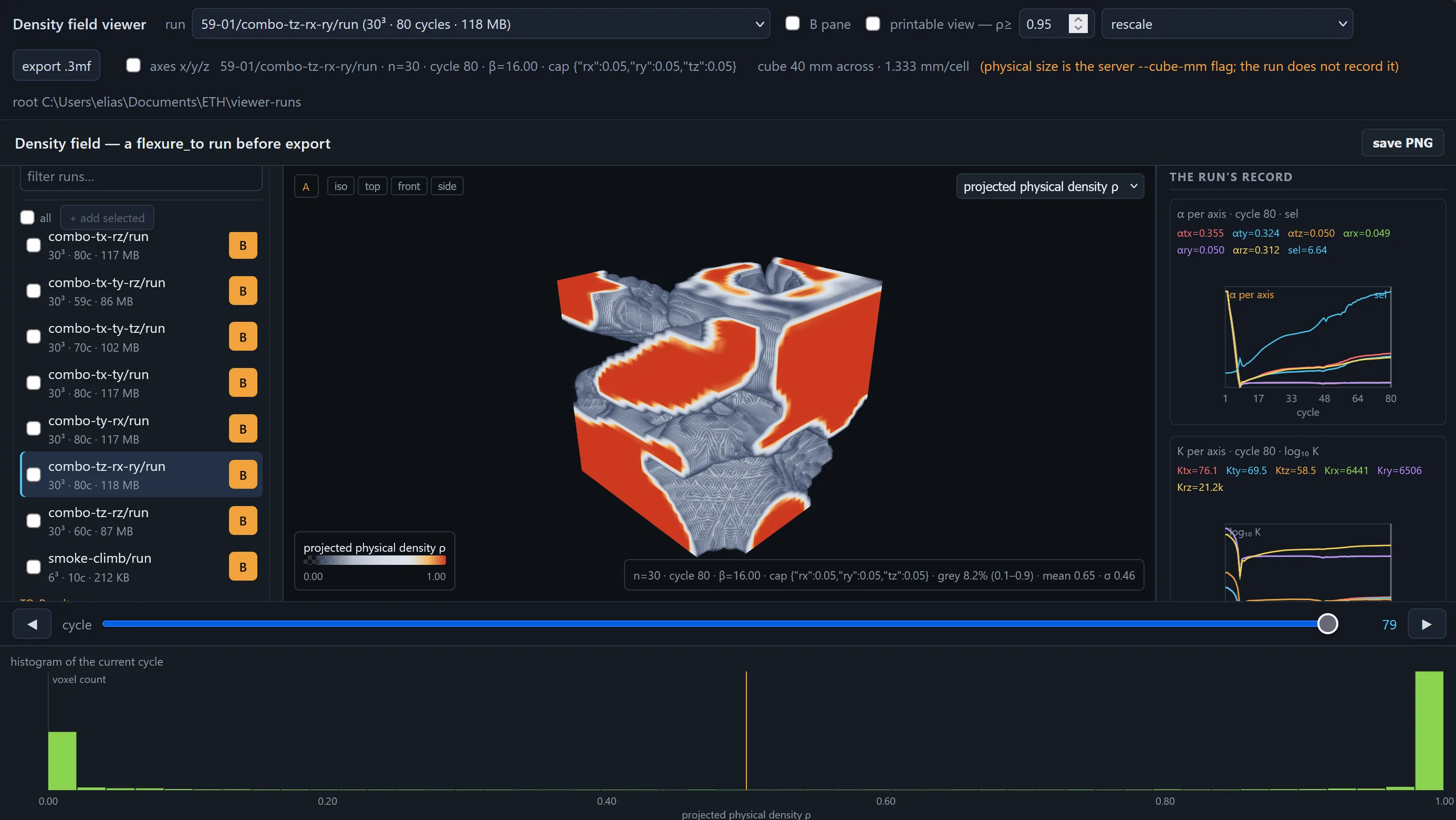
The density viewer used in the design loop: the run list, the density field at the selected cycle (red solid, grey intermediate, transparent void), and the energy, stiffness and histogram panels.
At a density cutoff of 0.5 or more, the export threshold shifts the measured energy secant by anything from 54.6 % lower to 17.9 % higher, depending on the body. Four parts were printed with the calibrated VarioShore filament (235 °C, extrusion multiplier 0.52). Three are flexures; the solid part is the reference cube.
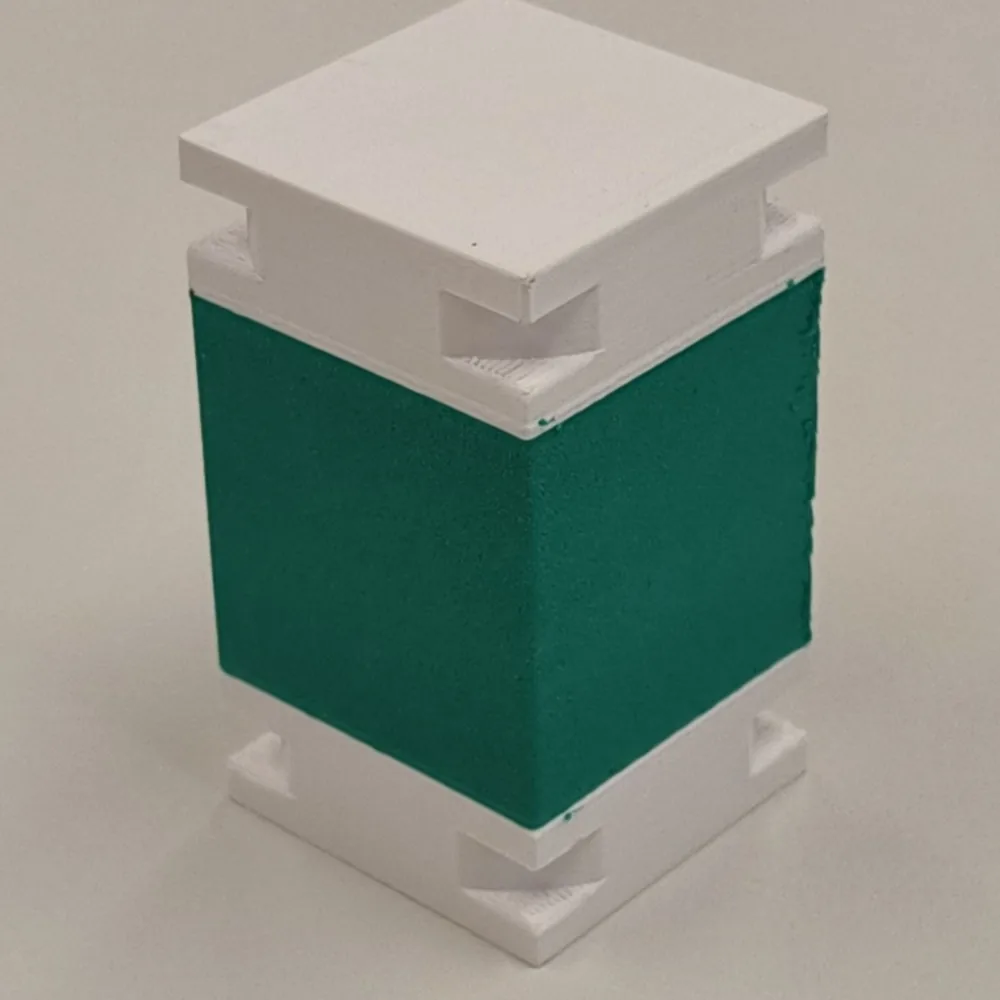
solid · reference cube
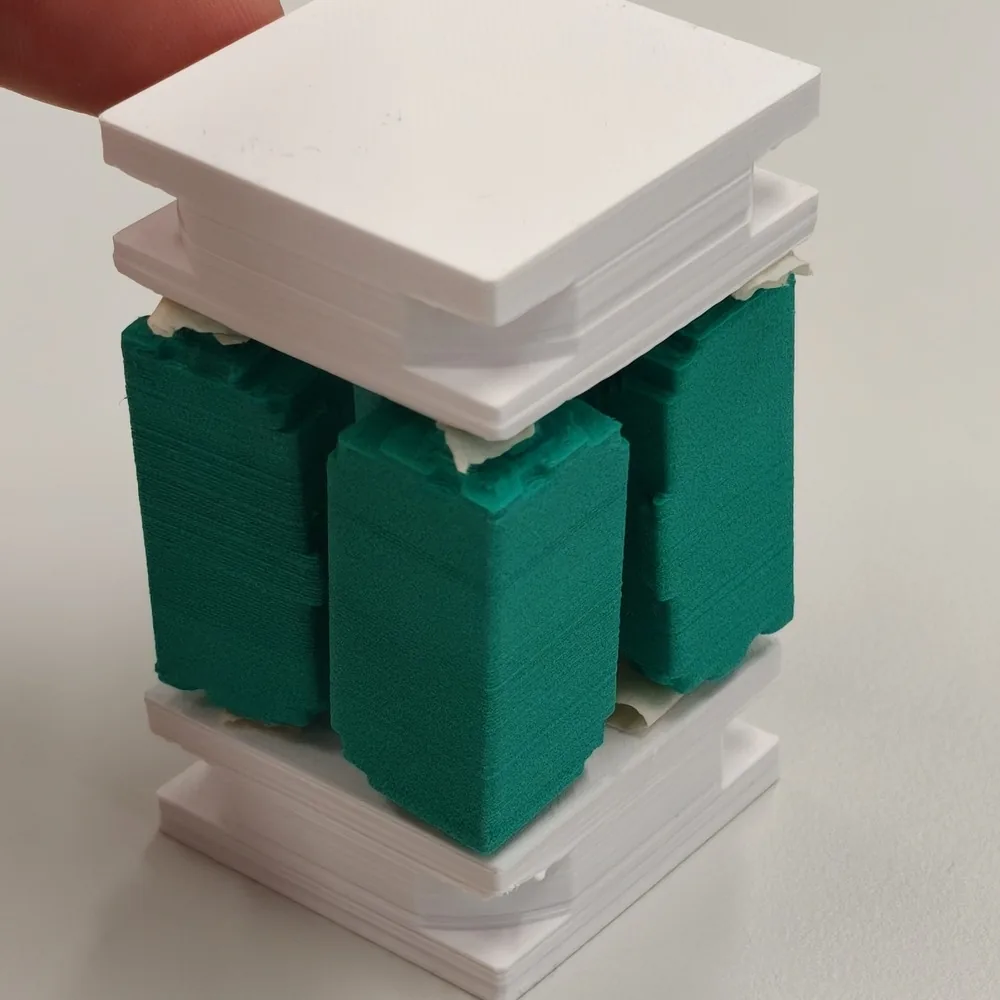
txty · two-translation flexure
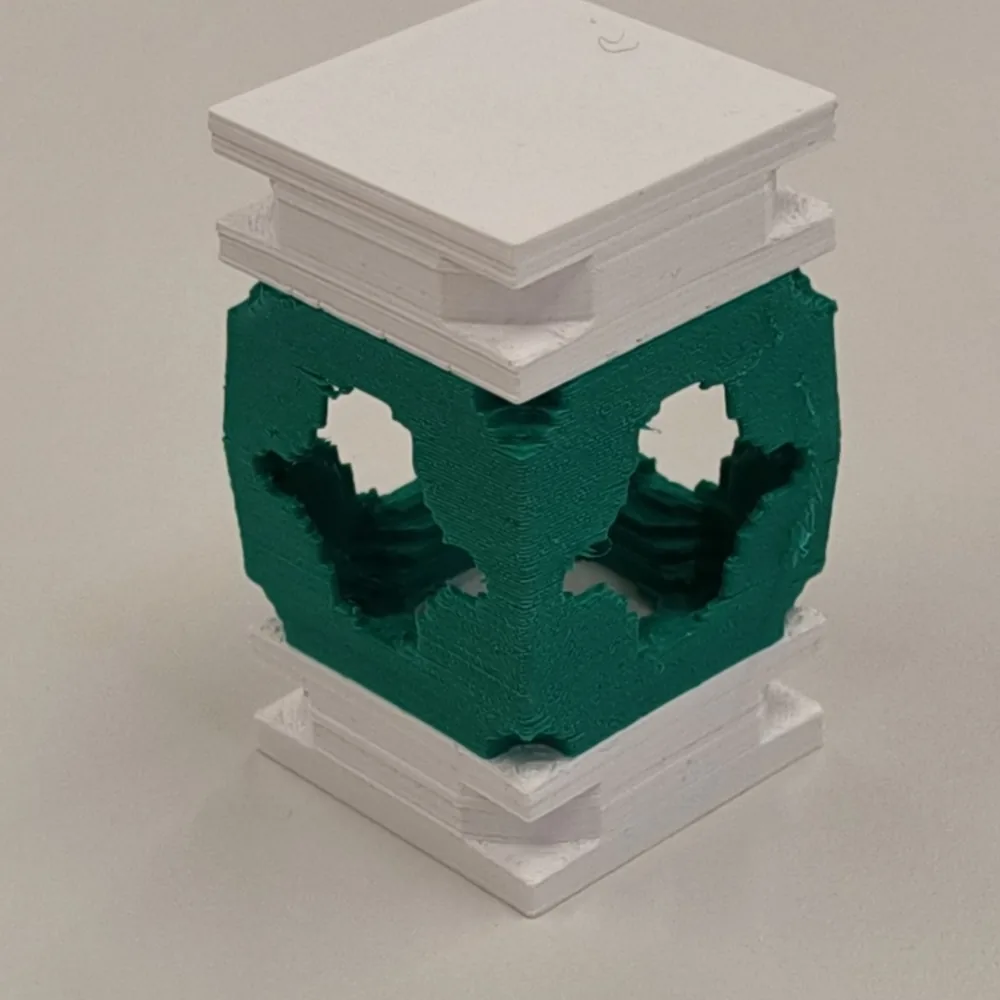
txtytz · three-translation flexure
tzrz · translation and rotation flexure
The foaming TPU VarioShore leaves its plateau between 215 and 220 °C and reaches 1.94 times its free width at 240 °C. Compensated prints stay within 0.06 mm of the 0.40 mm target, and within 0.03 mm from 230 to 240 °C.
The modulus of the foamed solid is still missing and is the largest open number. Taken together, the results describe what each step does, and they are the inputs for predicting the stiffness of a printed part one step at a time.
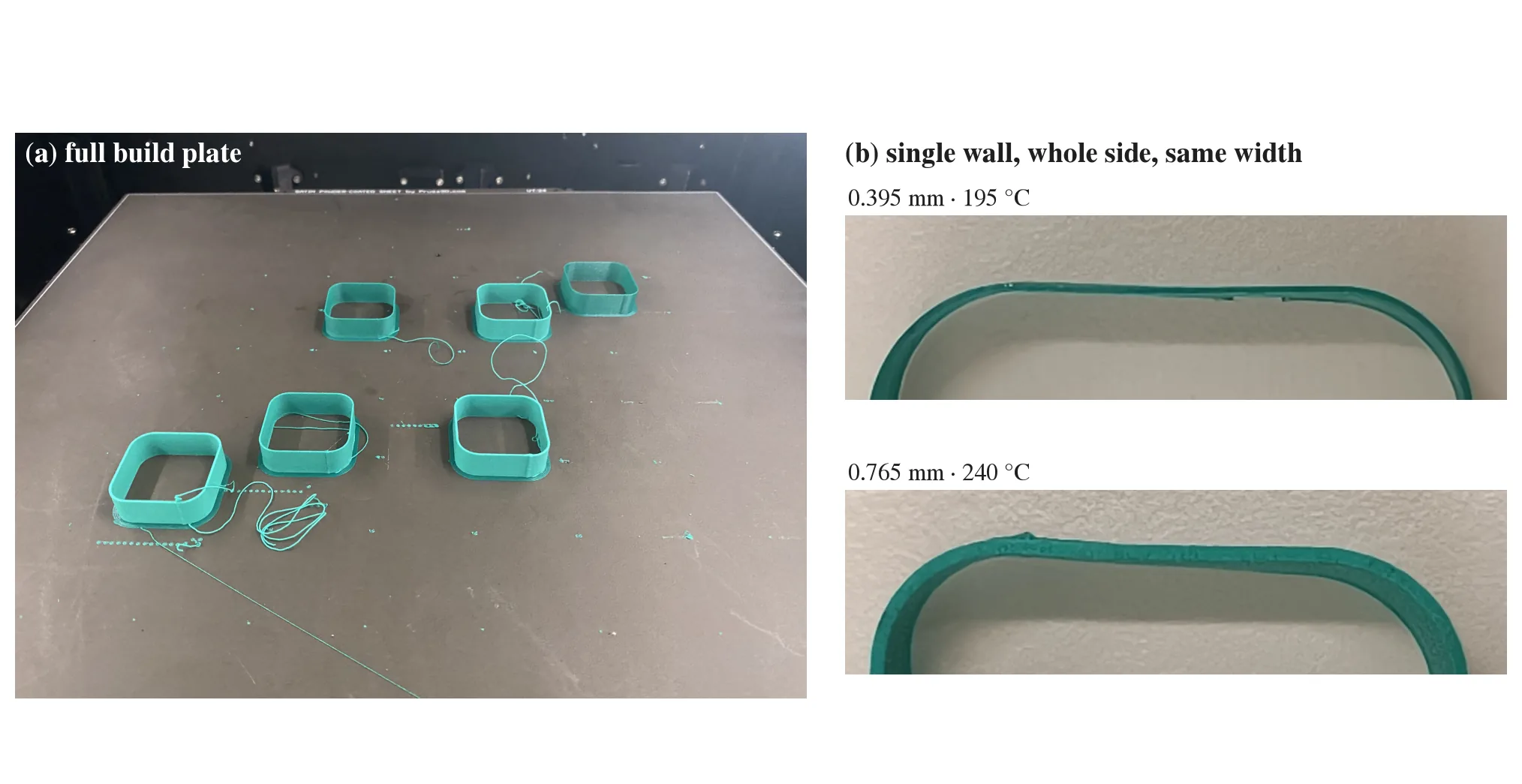
VarioShore calibration: the Prusa XL build plate with the six wall specimens of the nozzle-temperature ladder, and whole-side views of a 0.395 mm wall at 195 °C and a 0.765 mm wall at 240 °C.
Stored-energy gap between the inherited Abaqus pipeline and the new Firedrake loop.
Full stroke reached by five separate single-axis designs.
Free width expansion of the foaming TPU VarioShore at 240 °C.
Deviation of compensated prints from the 0.40 mm target, 230 to 240 °C.
The full thesis, with the methods, the complete results and the appendix on code and data, is available for download.